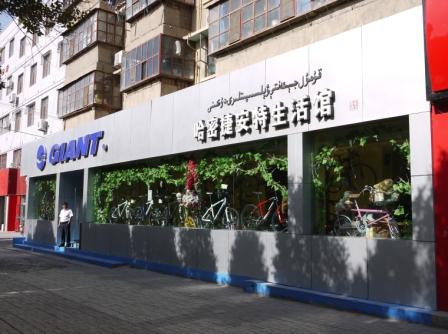
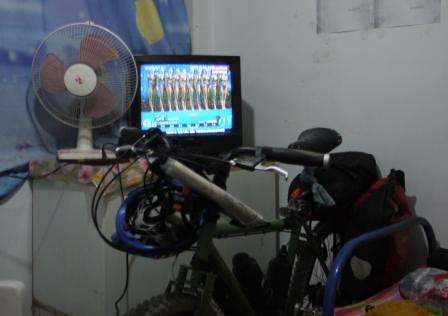
Led up to the third floor by the hotel receptionist, I’d assumed I was being taken to inspect a room. But no, to the manager’s office. Exactly why was unclear at first, my phrase book, and rudimentary grasp of the language, normally sufficient – just – to secure somewhere to stay. And then I noticed the computer. They’d found a website that could translate, and one of the domestic staff spoke a little English. Able to negotiate a very favourable rate, a generously sized room to myself for roughly the cost of a Youth Hostel bed in the UK.
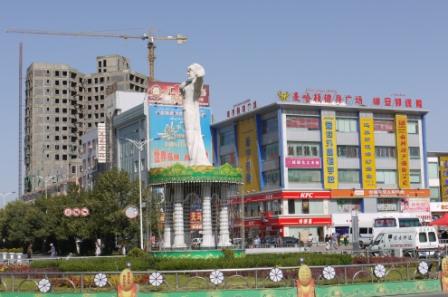
I’d reached the city of Urumqi, at the centre of Asia, the place furthest from any ocean on the planet. It should have been straightforward enough. I’d a map of the city centre, and, using Google Earth, had found a route through the suburbs. But then I’d discovered that my road map had confused the provincial dual carriageway with the new motorway. Forced to find a different way into the city, I’d eventually got my bearings by locating the airport, sitting on the hard shoulder watching for planes taking off.
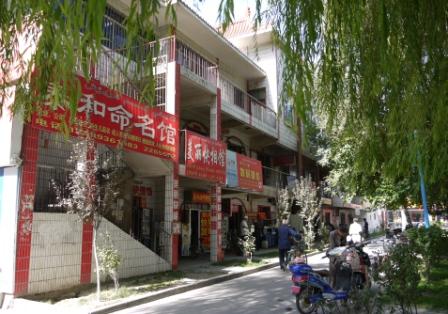
My bicycle secured in the room, the staff had decided I needed a Chinese name. The reverse is common practice, back in Shihezi, Mao calling herself Jennifer, her son Andy, Zheng at the language school introducing himself as Mr Johnson. I was to be named Wang Jia - 王佳 in Simplified Chinese. Means family reunion, harmony, or something like that. Apparently. And extends my vocabulary to about four words. The other two are Nihow -你好- hello – and Sheshe nee -谢谢- thank you. Add lots of smiling and they go a long way.
"Never tire to study – And to teach others" – Confucious
Explaining the relationship between terms like UK, England and Britain probably wasn’t the simplest of topics to tackle, but I was pleased we’d avoided plunging further into ethnicity, my knowledge of Angles and Saxons hazy at best. I’d been invited to give a seminar at Zheng’s English language school.
Some had studied English at University, keen to polish their skills, others still grasping the rudiments of the language. But all hugely enthusiastic. And joined by a couple of Pakistani medical students, studying in the city.
Lots of questions. Curiosity. Why had I come to China? What did I think of the country? Except for the medical students, and Zheng who’d previously worked as an interpreter, none had ever been beyond their own borders. That, I was told, was not easy to do. Red tape.
A small pavement cafe. Few hours after sunrise but already quite warm, the sun bright in my face, but not yet blinding. I’d joined Zheng and his daughter for breakfast. Steamed dumplings, some filled with soybean paste, others chopped herbs. And soybean milk. Pleasant tasting, refreshing.
I’d reached the city of Shihezi the previous evening, meeting up with Mao who’d translated my map a few days earlier. We’d been joined by Zheng. He ran a local English language school, and they’d both offered to act as guides the next day.
Breakfast finished, joined once more by Mao, we wandered amongst a few of the city’s parks, some of its many open spaces, along wide boulevards. Ordered. Not just a grid layout but a city with sharply defined edges. Rectangular.
And then a visit to the local museum. Outside a nondescript municipal building. Inside the story of the city’s creation, just sixty years earlier amongst the desert sands, retold with great aplomb. Static exhibits, audio-visual presentations, of a standard more readily associated with a national institution.
Courtesy of friends at my local community radio station in Somerset, England – www.10radio.org- you can catch up with my regular monthly on air chats with the Saturday Morning WakeUp team. Just click on the links below to hear the latest instalments.
"China Customs. Nyet" explained the Kazakh border guard, making a cross with his arms. Familiar words. I’d reached the edge of the Granitsa, the strip of land a few kilometres wide bordering neighbouring China,barbed wire and frequent watchtowers along its edges.Closed to all but local residents.
I smiled. I’d half expected this. But this time I’d plenty of time remaining on my Kazakh visa, and months before my Chinese one would expire. I could afford to be patient, to wait. "Tomorrow. Seven am" the guard explained. Progress I thought, turning around to find somewhere to stop for the night.
Parting company with New Zealand long-distance cyclists Mike and Joe the previous day, I’d eventually found a cheap hotel for the night. As the afternoon had worn on I’d felt increasingly nauseous, the saddle ever more uncomfortable, the pace ebbing away. But, relieved to be off the road at last, I’d mustered the enthusiasm to negotiate the rate down to a little under ten pounds. Fair. Settling up the next morning, the owner had sought his original offer, almost double what we’d agreed. "Nyet" I said firmly. Deal’s a deal I explained. He nodded reluctantly.
The final hundred miles or so to the Granitsa had been hard work, despite an early start in the relative cool of the morning. By ten am it was in the thirties, the flat, mostly arid plain offering precious little to distract from the heat. Koktal, Zharkent, towns I’d passed through on my previous foray to the border, drifted past, inconsequential now. I was bound for China, the frontier town of Khorgas.
Their plates were empty, mine still largely untouched. I apologised for talking so much, the opportunity for conversation in a shared native tongue irresistible. But I think they understood, they’d encountered solo travellers before, had said so much when they’d been given the chance.
Mike and Jo were fellow long-haul cyclists, New Zealanders who’d ridden from Beijing with an eye towards France. We’d met by chance at a small cafe at the top of the Kokpek Canyon in eastern Kazakhstan. They were trying to fathom the menu as I arrived, their cycles, from the same bike builder as my own, immediately catching my eye.
Some striking similarities, not just the choice of equipment. Philosophy, how they approached life on the road, resolved the inevitable problems, issues that cropped up from time to time. But still lots to share. And then off on our separate ways, they to find a secluded spot to camp, myself on towards the Chinese border.
[Title inspired by Mike and Jo’s choice of bicycle - the Thorn Nomad]
Think she’d taken a bit of a shine to me. Ordinarily, a little less than ten pounds a night got you a bed, no more. But Maryam the cook had other ideas. Breakfast once the dining room was quiet, a film crew using the guest house as a base. Compliments of the house, Benny the manager explained. But it was dinner I enjoyed the most because I was invited into the kitchen, encouraged to tuck into generous plates of food. I doubted if many were so permitted.
Thirty or so guests to cater for. Plates of neatly chopped herbs, tomatoes, peppers. Carefully ordered fridge. Impeccably clean work surfaces. Joined by the Spa staff as service approached, there was a warm communal atmosphere, everyone pitching in. But you knew who was in charge, unspoken. I’d offered to help, but that wasn’t allowed. Not in Maryam’s kitchen.
Bayseit was typical of many of the small linear settlements I’d passed through in eastern Kazakhstan. A wide, tree-lined boulevard, small, single storey houses set back a little along either side. Along the roadside watermelons stacked up on rush matting, the odd one cut open to reveal its succulent, tempting red flesh. Further down, fruit and vegetable stalls, packed closely together, almost indistinguishable. Midway along, a hotch-potch of cafes, some just a few tables in the shelter of the trees. The enticing aroma of meat being grilled over hot coals.
I’d ended up here the previous day, arriving in the last remnants of the evening light. The plan had been to stop earlier in a small hostel, largely frequented by itinerant workers. I’d spent a night there during my previous return to Almaty. Typical of those run by ethnic Russian women, it was basic but always clean and welcoming. Or it would have been, had it not been closed for major refurbishment.
There’d been no choice but to press on, assured by a few locals that there was a similar establishment in the next town. In any case, I couldn’t camp where I was. So I’d hastily departed, a little unsure as to exactly how far I’d have to ride. In practice, it hadn’t been that much further, perhaps six or seven miles, but locating the guest house hadn’t been easy. Eventually, stopping at a petrol station at the far end of town to ask if they knew where it might be, a car was summoned to guide me there, a few hundred metres back along the road.
A drive way led up to a house set back quite some way from the road, nothing to indicate that it might be a guest house. In what little remained of the light I could pick out some substantial log built cabins, and a large, immaculate white house. I was greeted, in perfect English, by Benny. The place was a Spa, he explained, owned by one of the large Almaty hotels. He looked after it for them, together with a few others from India and a small local staff. Sensing I feared a night here was quite beyond my budget, he added there were rooms in the house for just two thousand Tenge – about ten pounds. I accepted at once, relieved to be off the road at last.